
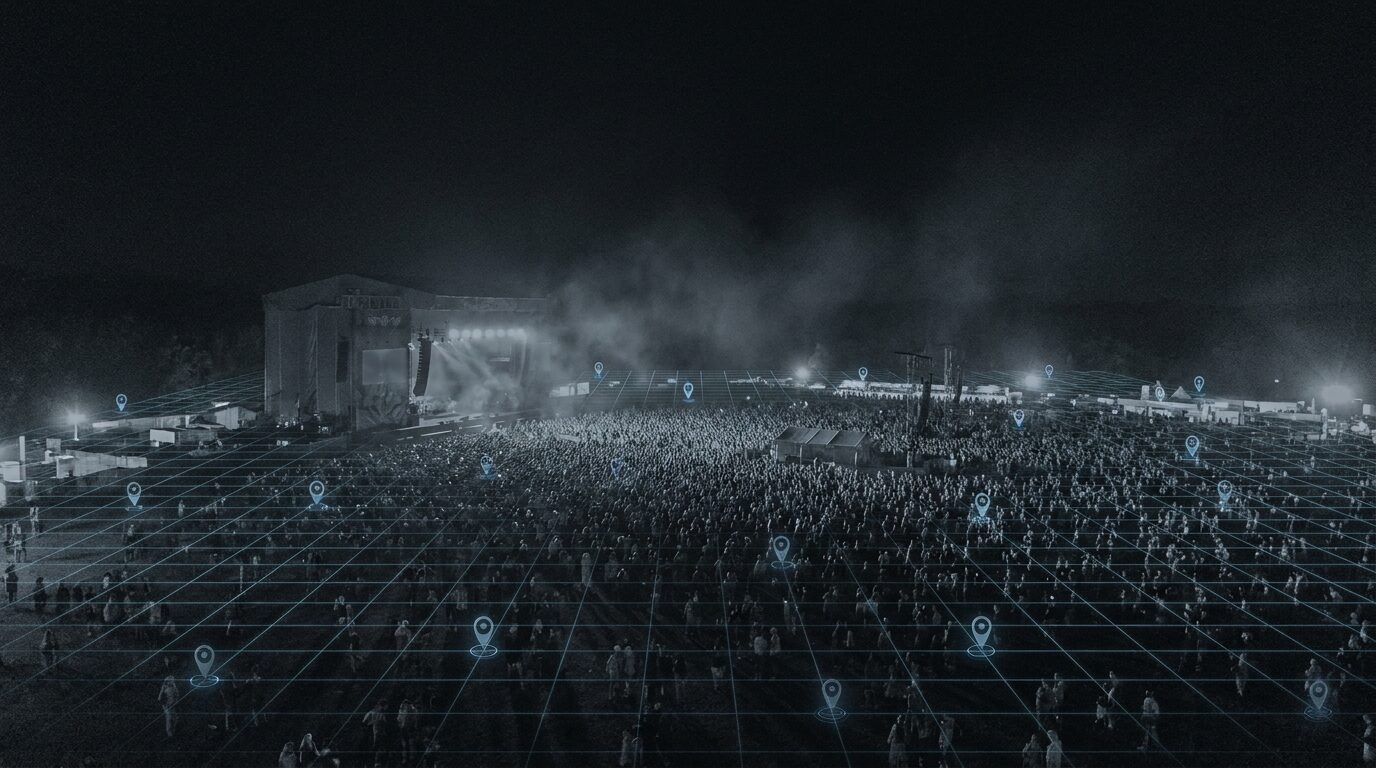
Live events have a safety gap. The data shows it.
Harassment, medical emergencies, and crowd incidents converge at every large gathering. Most go unreported, and the organizers responsible carry the cost. None of it has had a real-time technological answer.
The harm is happening. The reporting isn't.
People experience harm at events far more often than venues ever hear about. When reporting means finding staff, making a scene, or pulling out a phone, most people stay silent.
People want to report. The moment stops them.
83% of women say they want better safety at nightlife venues. The problem is the moment itself: in a dark, loud, crowded room, the steps to get help — find staff, unlock a phone, make a scene — are exactly the steps a person in distress can't take.
- Find staff in a crowd of thousands, in the dark
- Pull out a phone with dead battery or no signal
- Unlock an app and navigate it while panicking
- Make a visible scene in front of the person they're reporting
- Trust that a name attached to a report won't come back on them
Want-better-safety figure: YouGov / Secured by Design, 2021
Crowd safety failures are predictable — and catastrophic.
The worst outcomes aren't freak accidents. They're failures of real-time information: no one knew what was happening, where, in time to respond.
Astroworld Festival, 2021
Ten people died of compression asphyxia during a crowd surge and roughly 2,400 sought treatment. More than 300 injury lawsuits followed. There was no real-time crowd-density or distress signal to act on.
Houston Public Media; public court recordsIt scales with the industry
Live entertainment is a growing market — roughly $203B in 2025, heading toward $270B by 2030 — and Live Nation alone reported a record 151M fans across 50,000+ shows in 2024. More events, denser crowds, same blind spots.
MarketsandMarkets; Global Growth Insights, 2024For the people running the event, this is liability.
The buyer's real motivator isn't only care for guests — it's risk. A negligent-security claim or a compliance failure can cost more than a season of events.
RaveSafe costs a fraction of a single claim — and creates a documented record that the organizer acted.
The gap is real. So is the fix.
RaveSafe puts a discreet way to report in every guest's hand and a real-time picture in front of every responder.